
Risk Warning:
CFDs, Forex, and Cryptocurrencies are complex instruments and come with a high risk of losing money rapidly due to leverage and extreme market volatility. You should consider whether you understand how these markets work, and whether you can afford to take the high risk of losing your money.
You do not own or have rights in the underlying assets. Past performance, including the success rates of previous signals or copy trading strategies, is no indication of future performance.
No Financial Advice:
The information provided by SRFXGlobal—including but not limited to VIP signals, chart analysis, mentorship programs, Telegram alerts, and content distributed across all platforms—is strictly for educational and informational purposes. It is general in nature and does not constitute professional financial, investment, or trading advice. It does not take into account your personal objectives, financial circumstances, or needs.
Service Disclaimer:
Service Disclaimer: Engaging in copy trading, utilizing account management services, or following trading signals carries inherent risks. SRFXGlobal and its team are not liable for any financial losses incurred as a result of using our services, following our analysis, or executing trades based on our alerts. Technical factors, such as execution delays or platform latency, may impact results. Trading in financial markets involves significant risk, and you are solely responsible for your own trading decisions.
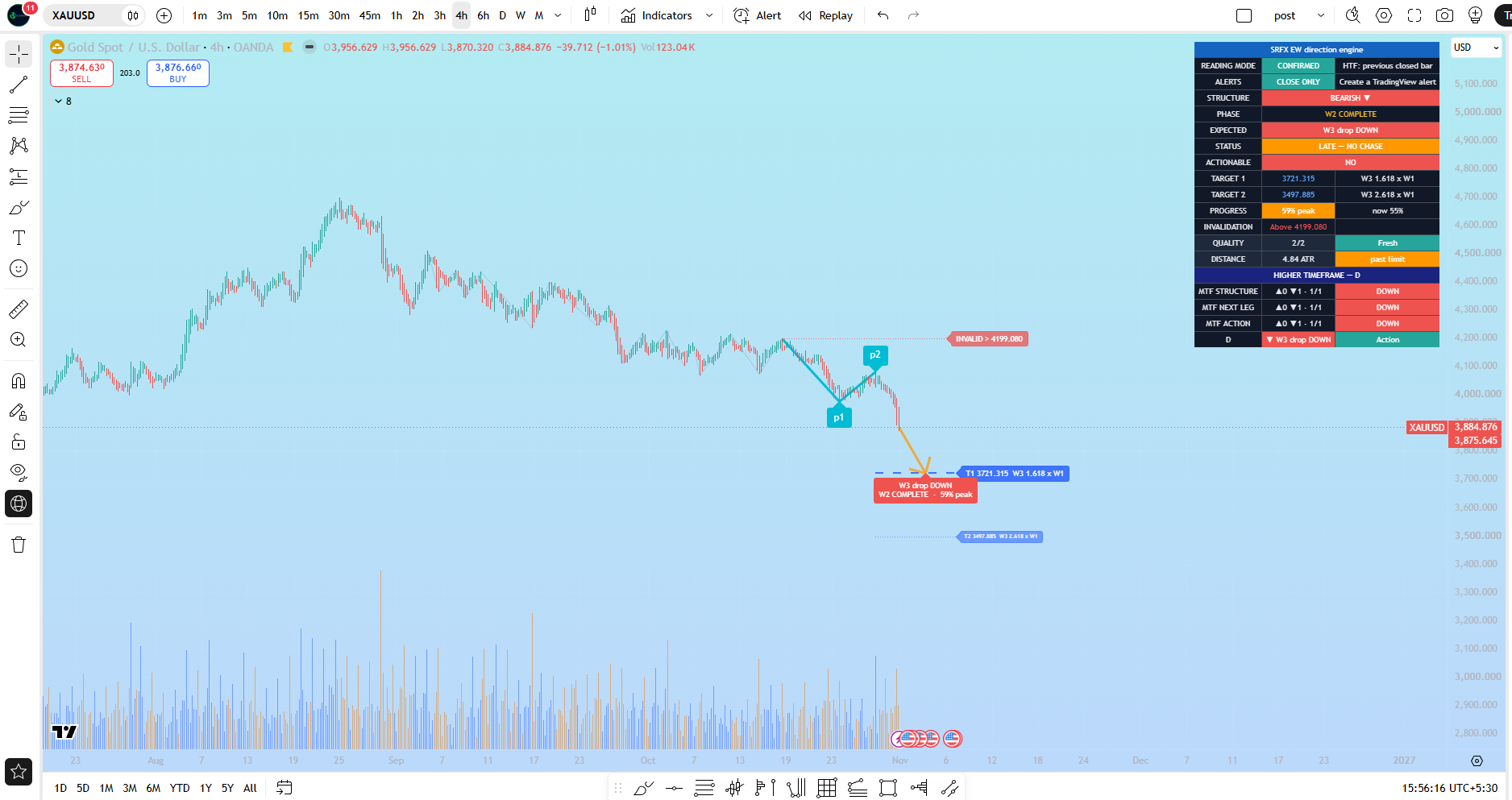
Its purpose is to support directional analysis. It does not place trades, define a complete trading strategy, or provide a standalone entry signal.
HOW THE ENGINE WORKS
The indicator builds a ZigZag structure from confirmed swing pivots and evaluates candidate wave counts using price relationships, wave proportions, freshness, and configurable eligibility filters.
It considers completed five-wave impulses and partial structures with two, three, or four completed legs. When full and partial candidates coexist, the engine compares eligible candidates using freshness and structural quality.
Quality scores describe how many programmed structure checks a candidate satisfies. They are not win rates, confidence percentages, or probabilities of reaching a target.
The main design feature is the separation of three readings:
• Structure direction: the direction of the selected impulse.
• Next-leg direction: the direction of the wave that may follow the selected phase.
• Setup availability: whether that scenario currently satisfies the engine’s availability filters.
These readings can differ without contradicting each other. For example, a completed bearish five-wave impulse can retain a bearish structure reading while the expected corrective Wave A points upward.
UNDERSTANDING THE WAVE PHASE
The engine uses the selected count to frame a conditional next-leg scenario:
• W2 complete: potential Wave 3 in the impulse direction.
• W3 complete: potential Wave 4 against the impulse direction.
• W4 complete: potential Wave 5 in the impulse direction.
• W5 complete: potential Wave A against the completed impulse.
These are interpretations of the detected structure, not predictions that a particular wave must occur. The engine does not attempt to identify every Elliott Wave pattern or resolve every possible alternative count.
READING THE STATUS
ACTIONABLE means the selected scenario passes the indicator’s current setup filters. It does not mean “enter now.” Entry confirmation, position sizing, stop placement, and trade management remain separate decisions.
SUPERSEDED means price has exceeded the pivot anchoring the current projection. The impulse direction may remain relevant, but the previous next-leg projection is withheld while the engine awaits an updated pivot. Targets and setup availability are withheld for that superseded projection.
LATE / NO CHASE means the move has already progressed too far toward its first objective or price is too far from the anchor under the selected settings. The structure can remain visible while setup availability is disabled.
NO OPINION means the engine has no eligible directional count under the current rules and available data. It should not be interpreted as a neutral-market forecast or a reversal signal.
TARGETS AND INVALIDATION
T1 and T2 are conditional Fibonacci reference levels derived from the selected wave structure. Their calculation depends on the expected leg, and a target can be omitted when it is incompatible with the applicable structure checks.
A target touch is a price event. It is not evidence of a profitable trade, because the indicator does not model entries, fills, fees, slippage, or exits.
The invalidation level belongs to the wave interpretation. It is not automatically a suitable stop-loss for an individual trade.
The progress filter tracks the furthest favorable wick since the anchor. A subsequent retracement does not erase earlier progress or automatically make a late scenario fresh again.
HIGHER-TIMEFRAME CONTEXT
The indicator requests one higher timeframe and reports its structure, next-leg, and action readings separately. Unused reference tiers do not contribute votes.
Higher-timeframe agreement can help contextualize a chart-timeframe scenario. Disagreement may indicate a correction within a larger impulse, a developing transition, or different selected structures. Agreement alone does not establish trade quality or probability.
Automatic higher-timeframe selection is available. When selecting a timeframe manually, choose one higher than the chart timeframe.
HOW TO USE IT AS A DIRECTION TOOL
1. Begin with standard candlestick charts and Confirmed reading mode. The supported chart-timeframe range is one minute through one day.
2. Read the selected structure and phase together. Determine whether the expected next leg continues the impulse or moves against it.
3. Check STATUS before using the arrow or targets. A visible directional structure may still be superseded, late, or otherwise unavailable.
4. Compare the chart reading with the requested higher timeframe. Distinguish agreement in structure from agreement in the next leg.
5. Use any available scenario as context for your own entry and risk-management rules. Do not treat ACTIONABLE, an arrow, or an alert as an instruction to buy or sell.
For example, BEARISH structure with an UP next-leg reading after W5 completion describes a possible upward correction within the selected bearish structure. It does not, by itself, establish a new bullish trend.
CONFIRMATION, DELAY, AND CHANGING LABELS
Confirmed mode uses closed chart-bar readings and the previous completed higher-timeframe bar. This introduces intentional delay.
Swing pivots require subsequent bars for confirmation. Wave labels are drawn at the historical pivot locations after detection; they were not available at those pivot bars in real time.
As new pivots become available, the selected count, drawings, targets, and directional interpretation can change. Confirmed mode does not make a wave count permanent.
Live preview displays developing values that can change before bar close. Its readings may differ from the final confirmed state. Alerts are paused in Live preview mode.
ALERTS
Alerts cover count, direction and phase changes; setup availability and withdrawal; supersession and invalidation; late conditions; target events; level changes; and higher-timeframe state changes.
To receive the combined event feed, enable alerts in the indicator settings and create a TradingView alert using “Any alert() function call.” Individual event conditions are also available.
Alerts operate in Confirmed mode at chart-bar close. Target-hit alerts require a newly observed hit on the same tracked count with an unchanged target; earlier historical touches are not sent as new events.
Text and generic JSON formats are available for the combined feed. JSON delivery requires a compatible receiving workflow. Recreate existing TradingView alerts after changing the script or its settings.
LIMITATIONS
Elliott Wave interpretation is conditional, and multiple valid interpretations can exist. Pivot sensitivity, available history, market volatility, and settings affect the selected count. Sideways or irregular price action can produce changing


